

PCI DSS Requirement 12.6 requires every person who works in or around your cardholder data environment (CDE) to complete security awareness training when they are hired and at least once every 12 months. As of November 2026, the phishing, social engineering and acceptable use requirements under it are fully mandatory, and an assessor will test them.
This post walks through each sub-requirement in plain language, what a Qualified Security Assessor (QSA) typically asks to see, and how Herd produces that evidence. The requirement text is from PCI DSS v4.0.1, published by the PCI Security Standards Council. Check the exact wording in the standard before you write it into a policy, because assessors test against the standard, not against summaries.
What does PCI DSS v4.0.1 Requirement 12.6 require?
Requirement 12.6 is titled "Security awareness education is an ongoing activity." It has five parts that matter for training: 12.6.1, 12.6.2, 12.6.3, 12.6.3.1 and 12.6.3.2.
The table below summarizes them. The wording is paraphrased from the standard.
| Requirement | What it asks for | Future-dated? |
|---|---|---|
| 12.6.1 | A formal security awareness program that makes all personnel aware of the information security policy and procedures and their role in protecting cardholder data | No |
| 12.6.2 | The program is reviewed at least once every 12 months and updated as needed for new threats and vulnerabilities that could affect the CDE | Yes |
| 12.6.3 | Personnel receive training on hire and at least once every 12 months, through multiple communication methods, and acknowledge at least once every 12 months that they have read and understood the policy and procedures | No |
| 12.6.3.1 | Training covers threats and vulnerabilities that could affect the CDE, including phishing and related attacks and social engineering | Yes |
| 12.6.3.2 | Training covers acceptable use of end-user technologies, in line with Requirement 12.2.1 | Yes |
"Future-dated" means PCI DSS v4.0 introduced the requirement as a best practice with a later deadline. That deadline is the next section.
When did the PCI DSS 12.6 requirements become mandatory?
The future-dated requirements became mandatory on March 31, 2025. The PCI Security Standards Council describes them in its post on adopting the future-dated requirements of PCI DSS v4.x, which says 51 of the 64 new requirements in v4.0 were future-dated.
PCI DSS v4.0.1, released in June 2024, is a limited revision that clarifies wording. It does not add or remove requirements. Before March 31, 2025, an assessor could treat 12.6.2, 12.6.3.1 and 12.6.3.2 as best practice and leave them out of a finding. Since that date, a gap in any of them can fail the control.
If your last assessment predates April 2025, expect the next one to test items that your previous one did not.
How often does PCI DSS require security awareness training?
PCI DSS requires training when a person is hired and at least once every 12 months after that. The standard states this in 12.6.3, and it sets the same 12-month interval for the awareness program review in 12.6.2 and for the policy acknowledgement in 12.6.3.
"On hire" has no fixed number of days in the standard. In practice, assessors compare the training completion date with the person's start date and expect a short gap. Treat the first couple of weeks as the safe range, and write your own number into your policy, because the assessor will hold you to it.
Three separate annual clocks run under Requirement 12.6:
- Each person's training (12.6.3)
- Each person's acknowledgement of the information security policy and procedures (12.6.3)
- Your review of the awareness program itself (12.6.2)
The program review is the one teams forget. It is a document, not a training completion, so it needs a dated record that someone reviewed the program and a note of what changed.
What does 12.6.3.1 require about phishing and social engineering?
Requirement 12.6.3.1 requires your training to include awareness of threats and vulnerabilities that could affect the security of the CDE, including phishing and related attacks and social engineering. The assessor tests it by examining your training content.
The standard does not require a phishing simulation. It requires that the training content covers the topic. A simulation is still the strongest evidence that the training does something, because a QSA who wants more than a slide deck can ask for your simulation results. That is a practice recommendation, not a PCI requirement.
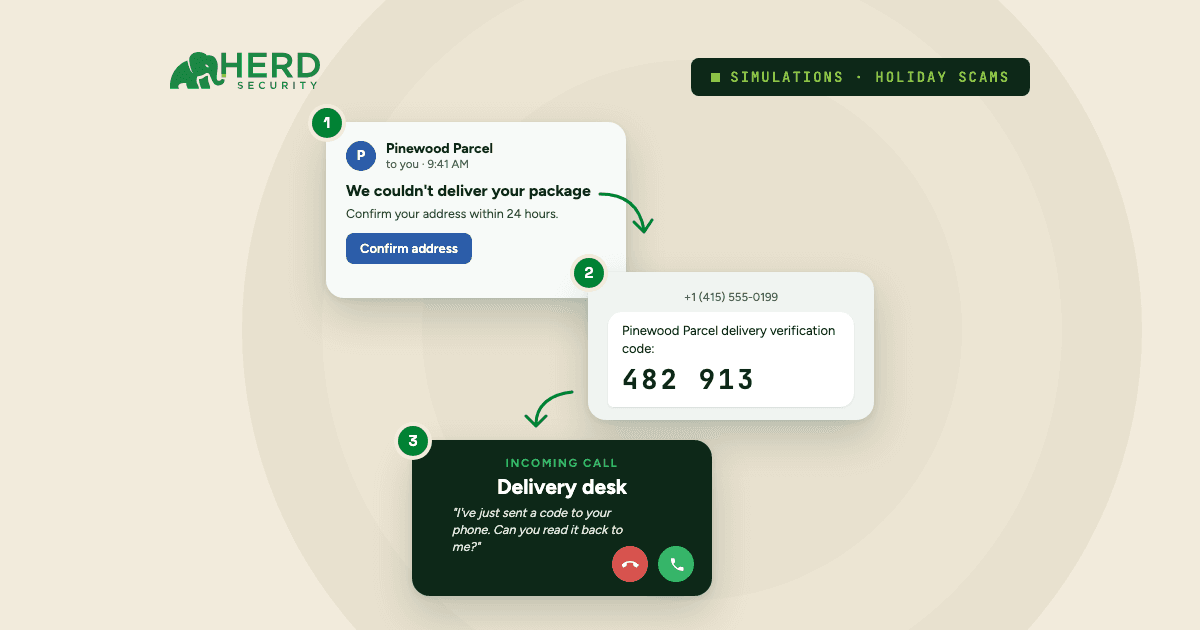
"Related attacks" is open ended. Attackers now reach people by SMS, voice calls, WhatsApp and fake video or voice calls as well as email, and a training program that covers only email phishing leaves most of the topic unaddressed. Because 12.6.2 requires you to update the program for new threats, a training library that has not changed in three years is hard to defend.
What does 12.6.3.2 require about acceptable use?
Requirement 12.6.3.2 requires your training to cover the acceptable use of end-user technologies, in line with Requirement 12.2.1. Requirement 12.2.1 is the one that says you must document acceptable use policies for end-user technologies such as laptops, tablets, phones and removable media.
The practical consequence is that your acceptable use policy and your training have to say the same thing. The assessor reads both. If the policy forbids personal cloud storage for cardholder data and the training never mentions it, that is a gap. Pairing the training with a signed acknowledgement of the acceptable use policy closes it.
What does a QSA ask for in a PCI security awareness assessment?
A QSA examines your training materials, your completion records and your acknowledgements, and interviews a sample of personnel. The testing procedures in the standard point to these items for 12.6.
- The awareness program documentation, to confirm it covers the policy, the procedures and each person's role in protecting cardholder data
- Training content, to confirm it includes phishing, social engineering and acceptable use
- Records of training at hire and at least every 12 months, per person
- Evidence of the annual program review and of updates made as a result
- The communication methods you use, to confirm there is more than one
- Acknowledgements that personnel have read and understood the policy, dated within the last 12 months
- Interviews with staff, who are asked whether they completed training and what their role is in protecting cardholder data
The records need to be per person and dated. A single line saying "100% completed in March" does not show who, when or against which version of the content.
Scope matters too. The requirement says "personnel," and PCI defines that broadly: employees, contractors and others who have access to the CDE or affect its security. Contractors and part-time staff are in scope.
How does Herd cover PCI DSS Requirement 12.6?
Herd delivers training in Slack and Microsoft Teams, runs phishing simulations across channels, collects policy acknowledgements, and exports per-person records. Together these produce the evidence in the list above. The mapping below uses Herd's documented features.
| PCI DSS item | What the assessor needs | What Herd provides |
|---|---|---|
| 12.6.1 | A formal program with scope and ownership | A compliance campaign tagged PCI DSS that bundles trainings, tracks and policies for a defined set of people |
| 12.6.2 | Evidence of an annual review and updates | Repeating assignments and annual cycles, plus the audit log and cycle history, show what ran and when |
| 12.6.3 training | Per-person records at hire and every 12 months | Automatic new-hire enrollment from your HR system or directory, annual cycles, and CSV exports with started and completed dates |
| 12.6.3 communication methods | More than one method | Training in Slack or Teams, email delivery for people who cannot be reached there, reminders, and simulations |
| 12.6.3 acknowledgement | Annual read-and-understood record | Policy acknowledgements delivered in Slack, Teams or email, with an exportable record of who responded |
| 12.6.3.1 | Content on phishing and social engineering | Phishing simulations over email, SMS, voice and WhatsApp (by plan), plus training on those attacks |
| 12.6.3.2 | Content on acceptable use | Your own acceptable use policy attached to the campaign for acknowledgement, plus training that Herd AI generates from your policies |
The campaign is the program. In Herd, a compliance campaign groups the framework, the trainings, the policies and the people. PCI DSS is one of the built-in framework options. You can narrow an item to part of the campaign, for example a CDE module that applies only to finance and engineering staff inside a company-wide campaign.
The annual cycle does the 12-month work. An ongoing campaign can run in yearly cycles, so everyone is assigned the items again every 12 months. The cycle history lists each person's window and whether it shows as completed, lapsed or open, and it exports to CSV for an auditor. Starting a cycle is recorded in the audit log.
New hires are enrolled on their own. A campaign can enroll people whose start date falls inside a window you set, using the hire date from your HR system (Workday, BambooHR or Rippling) or the account creation date in your directory. That gives you a start date and a completion date for the "on hire" test. People who reach Herd without a start date, such as through a CSV import, have to be assigned by hand.
Reminders run without a spreadsheet. Incomplete assignments are nudged in Slack or Teams during each person's business hours, and escalations are configurable.
Training is written against your policies. Herd AI reads the policies you upload and generates training from them, which helps when 12.6.3.2 asks that the training match your acceptable use rules. Upload the acceptable use policy and the information security policy, attach them to the campaign for acknowledgement, and the training and the policy stay aligned.
Herd does not decide what is in scope for your CDE, and it does not replace your 12.6.2 review. It records that the review's changes shipped. A person on your side still has to do the review and date it. And simulation channels depend on your plan, so confirm which channels you have before you describe them to an assessor.
For more on how this fits the broader picture, see Herd's security awareness training and its cross-channel phishing simulations. The same setup also covers SOC 2 training evidence, which matters if you hold both.
What does an audit-ready PCI training file look like?
An audit-ready file has four items you can hand over in one sitting: the program document, the content, the records and the acknowledgements. Build it before the assessor asks.
- A one-page program description naming the owner, the audience, the topics and the review date
- The training content itself, with version or date, showing the phishing, social engineering and acceptable use sections
- A CSV of every in-scope person with hire date, training completion date and the date of the next due cycle
- A CSV of policy acknowledgements with dates
- Your annual program review note, with what you changed and why
If you can produce those within an hour, the Requirement 12.6 section of an assessment becomes short. If you cannot, the usual cause is that records live in three places. A single platform that holds the training, the acknowledgements and the exports removes that problem. Pricing starts at $100 per month, and the details are on the pricing page.
Where does PCI DSS fit with other frameworks?
PCI DSS Requirement 12.6 overlaps heavily with the training controls in other frameworks, so one program can serve several. The NIST CSF and SOC 2 both expect role-appropriate awareness training with records, and a campaign in Herd can carry more than one framework. Smaller teams can start from compliance for SMBs.
SOC 2 leaves frequency to you. PCI names 12 months and the topics.