

Adaptive Security and Herd both use AI to make security awareness training feel less like a yearly checkbox. Adaptive Security leads with simulated attacks. Herd leads with training that reaches people where they work and produces compliance evidence. This post compares them as of November 2026, using each company's own public pages, and says plainly where each one fits better.
Herd is our product, so read this with that in mind. Every Adaptive Security statement below links to its own site, and anything we could not find there is marked "Not published".
Who is Adaptive Security for, and who is Herd for?
Adaptive Security describes itself as an AI-powered platform for security awareness training and attack simulation. Its site organizes solutions by company size (enterprise, mid-market and SMB) and by industry, and says it is "Trusted by over 2,000 customers". It also sells separate email security and AI governance products.
Herd is a human-risk platform for security and compliance teams, with a focus on lean teams that need training done and provable. Its tiers run from a $100 per month startup plan for organizations under 25 employees to flat-rate and per-user plans for larger companies (see pricing).
How do Herd and Adaptive Security compare feature by feature?
The table below summarizes the comparison as of November 2026. Adaptive Security entries come from its public pages, linked in the sections that follow. Herd entries come from Herd's product documentation.
| Capability | Adaptive Security | Herd |
|---|---|---|
| Training generation | "Create with AI" feature for building training content | Generate a training from a topic or reference material with Herd AI, then edit it |
| Email phishing simulation | Yes, AI-generated from OSINT data | Yes |
| SMS simulation | Yes | Yes, on the Enterprise plan |
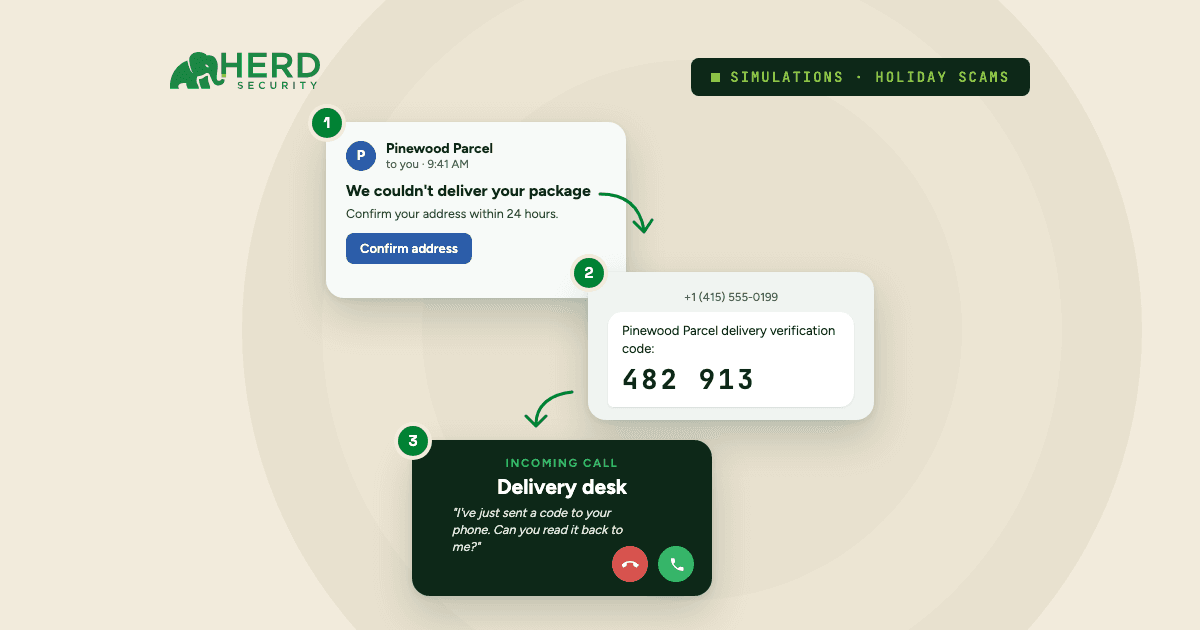
| Voice simulation | Yes, voice cloning and voice attacks | Yes, on the Enterprise plan: a text with a code followed by an AI voice call that asks for it back |
| Deepfake | Deepfake video and audio simulations | Voice-cloning step inside a training (Slack only), plus training videos with an AI likeness of your own executives |
| Slack simulation | Not published | No Slack phishing simulation is documented. The voice deepfake training step runs in Slack |
| Teams simulation | Not published | Not documented. The voice deepfake step does not run in Teams |
| Training delivery in Slack | Not published | Yes |
| Training delivery in Teams | Not published | Yes |
| Compliance reporting | Audit Preparedness board and compliance status dashboard | Reports page with CSV export for auditors, plus Drata and RegScale integrations |
| Setup time | Not published (site says onboarding is rated highly) | Not published as a fixed time (the startup plan is pitched as compliance training done in a week) |
| Pricing transparency | Not published, per seat quote | Published, from $100 per month |
What does Adaptive Security do well?
Adaptive Security is strongest at simulation realism. Its phishing simulations page lists email phishing generated from OSINT data, voice and SMS attacks with voice cloning, attachments, QR codes, and "realistic deepfake video and audio simulations". It also describes coordinated attacks across email, voice, SMS and chat. That breadth in one product is hard to match.
It also has a wider product footprint. Beyond training, it sells agentic email security and AI governance. Its reporting page describes an Audit Preparedness board, a compliance status dashboard, and SIEM and GRC integrations.
Where is Adaptive Security the better fit?
Adaptive Security is the better fit if realistic attack simulation is the center of your program. Specific cases:
- You want deepfake video and audio simulations aimed at employees themselves.
- You want one vendor for awareness training plus email security.
- You are an enterprise buyer comfortable with a quote-based, per-seat process.
- You want training and simulation reporting delivered through executive board templates.
Where is Herd the better fit?
Herd is the better fit if you want training that is easy to keep current and easy to prove to an auditor. Specific cases:
- You want training generated from your own policies and topics, then delivered inside Slack or Microsoft Teams, with an emailed link for people who use neither.
- You need compliance evidence for an audit. Herd exports report data as CSV for auditors and pushes training completions and policy attestations to Drata.
- You are a small or growing company and want to see the price before talking to sales. The startup plan is $100 per month and the flat-rate plan starts at $5,000 per year.
- You want a voice-cloning exercise where a learner hears their own voice cloned, as one step in a training. Note that this step runs in Slack only.
For Herd's approach to training itself, see security awareness training and cross-channel phishing.
Is Herd a good Adaptive Security alternative?
Herd is a good Adaptive Security alternative if your priorities are generated training, in-chat delivery, audit evidence and published pricing. Skip it if your main requirement is deepfake video and audio attack simulation against employees. Herd's deepfake exercise is a voice-cloning step inside a training. It runs in Slack only and cannot be launched as a standalone campaign.
Does Adaptive Security publish its pricing?
No. Adaptive Security's pricing page lists no prices. SMB buyers enter a work email to get pricing, enterprise is labeled custom pricing, licensing is per seat based on employee count and products, and add-ons such as voice phishing are priced separately. Enterprise pricing is labeled custom. Herd publishes its tiers on the pricing page.
How long does setup take?
Neither company publishes a fixed setup time as of November 2026. Adaptive Security's pricing page says customers "consistently rate onboarding a perfect score" but gives no timeframe. Herd's startup plan is pitched as getting compliance training done in a week, which is a goal for small teams and carries no guarantee for every deployment. Ask both vendors for a timeline tied to your identity provider and HR system before you sign.
Does Herd run deepfake simulations?
Partly. Herd's Voice Deepfake step records 5 to 10 seconds of a learner's voice with Slack's audio recording, clones it, and asks the learner to tell the original from the clone. Herd can also make training videos featuring an AI avatar and cloned voice of an executive, with that person's consent. Herd's separate voice simulation is a text with a code followed by an AI voice call that asks for the code back, and reading it back is recorded as a failure.
Which should you pick?
Pick Adaptive Security if simulation realism and a broader security suite matter most. Pick Herd if you want generated training, delivery in chat, audit-ready reports and a visible price. If you are also weighing a legacy vendor, see our KnowBe4 comparison and human risk management checklist. Herd's Slack integration page covers rollout.