
At a certain point, a brand becomes so popular that its name represents a whole category. You don’t whip out a “bandage” when someone gets hurt, you scrounge around for a Band-Aid. You don’t “apply lip balm” you reach for some Chapstick.
KnowBe4 is synonymous with security awareness.
If you need training, if you need simulations, if you need compliance training, you’ll probably check out KnowBe4. It’s been around for over 15 years, and widely considered a safe choice. But being the default doesn’t always mean you’re the best fit, and it certainly doesn’t mean you shouldn’t explore alternatives. Just look at how many people love Burt’s Bees.
So if:
- Your 3-year KnowBe4 plan is up for renewal soon
- You’re a lean team just starting to look for a security awareness platform
- A phishing incident exposed a gap your annual training never covered
It’s worth understanding what, exactly, KnowBe4 offers, and what other options you might explore. Below, we examine what KnowBe4’s strengths are and where AI security awareness platforms might serve you better.
What people like about KnowBe4
When most people seek out a security awareness program, they’re looking for an easy way to answer: “How do I prove I’m compliant?”
KnowBe4 is a logical choice because of its:
- Reputation. It’s been around for 16 years, hundreds of companies have passed audits with it, and most admins feel it’s a trustworthy solution. Users say things like, “If you set it up correctly, integrate it into your systems, utilize smart groups, etc. it is pretty hands off. Set it and forget it and you know it’s not gonna break on you randomly.” (Reddit)
- Library breadth and localization. KnowBe4’s got a large catalog of training courses that span multiple languages and security-related topics, as seen on G2:
- “Feels like a complete solution. They offer a lot of material across a wide range of topics,” (G2 review)
- “Providing material in multiple languages is one of the very good features for global organizations” (G2 review)
- Reporting. KnowBe4 lets you view risk scores at the user, group, and manager level, training completion rates, proficiency assessment grades, and how those have changed over time. It even tells you who in your org is most phish prone at a glance: “The platform makes it easy for admins to manage users, assign training, and monitor progress with detailed reporting and analytics.” (G2 review)
- A mature, complete feature set. KnowBe4 has automated campaigns, phishing simulations, assessments, recommended learning paths, automatic remediation training when someone clicks a bad link, and sensible grouping of users: “I like how granular it is. We are able to get training to the right groups through the use of smart groups, and are also able to complete required teacher training through the platform that would otherwise be difficult to administer through other channels.” (G2 review)
Where a library-first approach is too limiting
KnowBe4 is a library-first platform, meaning the company creates a huge catalog of generic content (courses and phishing templates). It’s great to have that much content at your disposal, but there’s a flip side to that coin. It’s on you to:
- Comb through it
- Assign modules by role and permission level
- Pick which pre-written phishing emails to send
Beyond the admin work, KnowBe4’s content isn’t as personalized and fresh as it could be.
Sure, the catalog gets updated on a regular cadence (according to KnowBe4, “continuously”). But you may have to pay extra to access new modules. On their pricing page, you’ll find that their Inside Man series, games, live-action videos, posters, newsletters are only available on the more expensive SAT Advanced plan. And Compliance Plus training starts at $0.93 per user once you have 100 seats.
Plus, these courses aren’t even tailored specifically to your organization’s policies or the people taking them. The less personalized they are, the less likely folks are to absorb the content, and the more human risk you take on.
AI-native platforms, on the other hand, are built to adapt to every user. Take Herd, for example. It’s picking up on a bunch of different signals to create and deliver the most relevant, most engaging forms of training and simulation automatically. It:
- Combs X, Reddit, and other security feeds for new scams as they surface, creating and deploying training and sims automatically.
- Reuses real phishing attempts that employees have previously reported as new simulations.
- Learns a company’s tool stack (login flows, notification formats, and email addresses your org uses), and inner quirks (down to how execs talk and what emojis people at the company use) to make phishing sims even more realistic.
- Delivers training specific to a person’s role and level of access, how they’ve performed on previous simulations or training quizzes, and what questions they’ve asked Herd’s AI coach.
How KnowBe4 stacks up to AI security awareness training platforms like Herd
If you’re working at a large enterprise with a person or team dedicated to just running security awareness training and managing a platform, KnowBe4 is a defensible pick.
But if you’re on a lean security team, want training that’s hyper-relevant to your people, and would rather the platform handle the busywork of assigning modules and pulling audit evidence, an AI-native tool can provide the support you need.
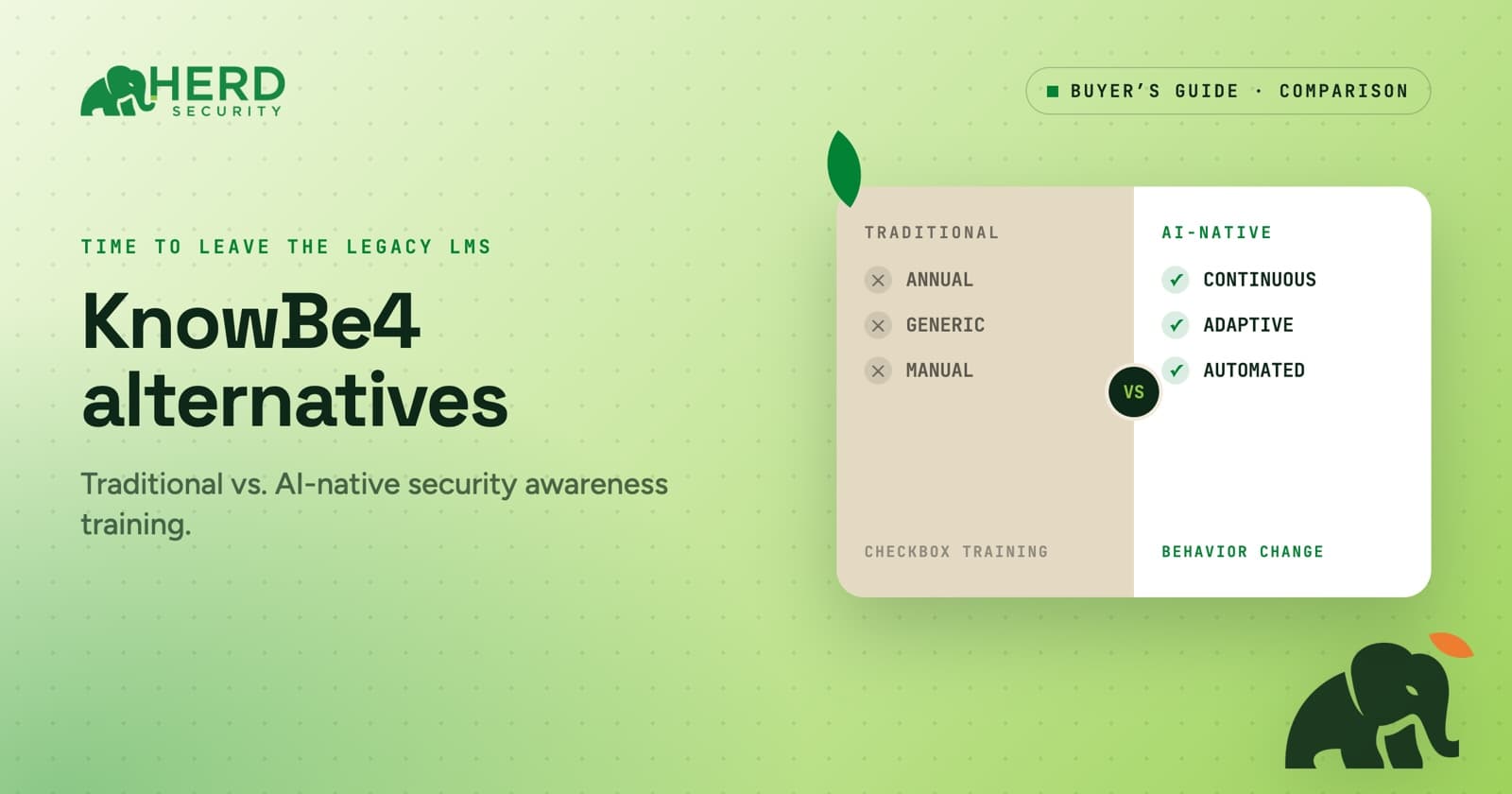
Read on for more detail, or check out this table if you only have time to skim:
| Dimension | KnowBe4 | Herd (AI-native) |
|---|---|---|
| Content model | Curated vendor library | Bite-sized modules (between 5 and 15 minutes) |
| Content freshness | Updated on the vendor’s release cadence | Generated directly from your security policies, tools, and threats |
| Multi-language | ~30 languages (can be the same language adapted to different regions) | AI can change a training to your preferred language |
| Customization | Limited; does allow you to upload your own training videos | Adapts to role, access level, and past performance |
| Delivery | LMS portal and email nudges | Native in Slack or Teams |
| Setup time | Weeks to months | Minutes |
| Phish reporting | Must install KnowBe4’s separate button in your email client | Uses report button already built into Outlook and Gmail |
| Simulation coverage | Email, smishing, vishing (voice) | Email, smishing, vishing (voice) |
| Reporting | Dashboards, manual exports for audit evidence must be requested through a KnowBe4 representative | Per-person and aggregate risk scores; can pull SOC 2 and other security framework evidence from Herd analytics yourself |
Content
KnowBe4
KnowBe4 has a wide breadth of training content, including video modules, mobile-first SCORM courses, assessments, games, audiocasts, and newsletters. It even has posters you can hang up in the workplace. And the catalog is being refined over time. Most recently, they released vishing training and simulations to keep up with AI-generated threats.
Where customization is limited is where teams get stuck. Admins can’t change what people say in videos, swap out new images, or adjust any of the information being presented. And when you read reviews, you’ll see people complaining about the KnowBe4 material, saying things like:
- “Absolute AI slop. Every video is fake to the point of being insulting. You can’t even focus on the content because you’re distracted by how repetitive, stilted, and artificial the ‘actors’ and scenarios are.” (Trustpilot review)
- “The training videos aren’t great and can be pretty corny without providing new information. I wish there was more relevant content and not as much training behind pay walls. The video series don't appeal to the kind of training we’d like.” (G2 review)
Worse, some customers say the training isn’t being internalized. Per one Redditor: “There seems to be no improvement in our phish-prone percentage, mostly because the training is not good and every employee just does it for the sake of it and doesn't incorporate anything.”
While you can construct remedial training campaigns for people who continue failing phishing tests, you have to create a remedial training group, a remedial training campaign, and a phishing campaign yourself.
Herd
Herd covers every channel hackers use (phishing, smishing, and vishing), and generates and adapts that content to new attack vectors all the time.
Its built-in AI coach adds more layers of education and awareness:
- It acts as an always-on assistant employees can ask to clarify a concept and solidify their understanding.
- It identifies risky employee AI use (secrets, PII, regulated data people include in their prompts) and offers guidance in the moment.
Simulations are built to mirror real-world threats at a difficulty matched to your team’s maturity, and every failure automatically triggers a short follow-up module, so remediation happens on its own.
As the Director of IT and Cybersecurity at an AI-powered software for military operational planning, puts it: “Herd allows us to ditch the boring long-form lectures, for short, timely refreshers that fit into our workflow. It’s helped us to build a proactive security culture without the training fatigue.”
Delivery
KnowBe4
KnowBe4 training happens in its portal (or your own LMS), which means users have to open another tab and enter yet another password. That may not sound like a big deal, but that friction can hinder completion rates, and the length of KnowBe4’s trainings doesn’t help.
As one user notes, “At times, some modules can feel a little long. We find shorter sessions, ideally under 10 minutes, are more effective at maintaining user attention and improving knowledge retention.”
Herd
Herd delivers training inside Slack and Teams, so there’s no LMS to get familiar with and no password to reset 48 hours before something’s due.
The training itself isn’t invasive either. Modules run 5 to 15 minutes, and if someone has questions, they can ask Herd’s AI coach and get walked through the answer.
On top of that, Herd drives completion by:
- Sending nudges during business hours over Slack and Teams, and falling back to email or SMS for people who ignore the first ones
- Escalating those nudges before a due date, and continuing on your cadence after it passes
- Looping in managers for stragglers who tune out every channel
The ChatOps integration is a game-changer for those responsible for administering trainings, and for the end user experience, so there’s no once a year training dread.
Reporting
KnowBe4
KnowBe4 has a robust set of reports, but not everyone trusts them. Many, many users complain about false positives:
- “The test email went to my junkmail folder, and I got dinged because I never reported it.” (Trustpilot review)
- “I have been flagged for two false positives so far this year! Both times I avoided clicking the link and simply used the ‘Report Phishing’ button in outlook. Yet I still would receive emails stating that I ‘failed’ and that I need to take a training module (due by the end of the same day which is also ridiculous had I been out of office).” (Trustpilot review)
- “Getting in trouble for links I never clicked. I am fighting vociferously for our workplace to get rid of this company’s scammy software.” (Trustpilot review)
Some users question the headline number these reports roll up into, KnowBe4’s Risk Score. As one Gartner Peer Insights reviewer points out:
“The score does not accurately reflect the overall risk level unless you’re running KnowBe4’s full product suite, which can lead to misinterpretation of the overall risk level. Additionally, new users are regularly onboarded and having their risk score remain high for 90 days inaccurately skews the organization’s overall risk score, making improvements difficult.”
On top of that, admins have trouble pulling people’s past scores. As one G2 reviewer notes, “When a user completes a training in 2025 the user cannot go back into the training tab and look to get their certificate from previously completed training.”
Herd
Herd is built to make reporting simple. It logs progress automatically and shows per-person and aggregate risk scores trending over time so you can spend your time helping the riskiest teams improve.
It also flags likely bots and shared mailboxes so service accounts don’t count, and connects directly to the tools your reporting already depends on: identity tools like Okta, HRIS platforms like Workday, Rippling, Gusto, and compliance software like CrowdStrike. And you can pull SOC 2 and other framework evidence at any time on your own.
Is it time to try a KnowBe4 alternative?
KnowBe4 built the category, and for some teams it's still the right call. But if you want training built specifically for your org and your people, that sticks in their brain, and deploys in minutes, it might be time to try something new.
See how Herd could look in your org with a personalized demo →